
7 Grammatical Errors That Aren’t

There are two types of grammar: Descriptive, which describes what is customary, and prescriptive grammar, which prescribes what should be. A tension between the two systems is inevitable — and healthy; it keeps us thinking about what we’re saying and writing.

Allowing mob rule at the expense of some governing of composition is madness, but a diction dictatorship is dangerous, too. As with any prescription, an overdose is contraindicated. Here are some hard pills to swallow for language mavens who require a strict adherence to rigid syntactical patterns at the expense of, well, language:

1. Never split an infinitive.
It isn’t wise to always ignore this fallacious rule against dividing the elements of the verb phrase “to (verb)” with an adverb, but to blindly follow it is to prohibit pleasing turns of phrase — one of the best known of which is from the introductory voice-over from all the Star Trek television series: “to boldly go where no one has gone before.” (The original series, produced before the more recent sensitivity to gender bias, put it “no man.”)

2. Never end a sentence with a preposition.
This rule is ridiculous, to start with. If you believe it, please tell me what planet you are from. What are you striving for? Give it up. Am I getting my point across?

The stricture against closing sentences with words that describe position stems from an eighteen-century fetish for the supposed perfection of classical Latin, which allowed no split infinitives — for the excellent reason that Latin infinitives consist of single words. English, however, being a distant relative of that language, should be allowed to form its own customs.

3. Never begin a sentence with a conjunction.
And why not? For an honorable tradition of doing just that exists. But some people persist in prohibiting this technique. Yet we defy them. Or we simply ignore them or laugh at them, neither of which they appreciate. Nor do they understand our attitude, though we try to convince them, and will continue to do so. So there.

The words beginning each of these sentences are conjunctions, easily recalled with the mnemonic FANBOYS. Every one is perfectly acceptable at the head of a sentence. As is obvious from the previous paragraph, however, a little goes a long way.

4. Distinguish between while and though.
Petty prescriptivists would have you reserve while for temporal usage only: “While I agree, I resist,” they say, should be revised to “Though I agree, I resist.” I freely admit that I often change while to though, and while I understand — I’m sorry, I can’t stop myself — and though I understand that it may seem pedantic, I think though reads better.

5. Distinguish between since and because.
Ditto. And ditto. I concur that indiscriminate replacement of since with because may seem persnickety, but since — ahem — because I find the latter word more pleasing, I will reserve the right to prefer it.

6. Use data only in the plural sense.
Where did they get this data? The alternative is to use datum in the singular sense, which makes you sound like a propellerhead. (Look it up, kids.) People who say “datum” get data, but they don’t get dates.

7. Use none only in the singular sense.
None of these rules, followed strictly, allow for a vernacular ease with language.

Did that sentence hurt? Did the waves stop crashing to shore? Did Earth stop spinning? If you wish to replace none with “not one” or “no one” (“Not one person admitted guilt”; “No one saw that coming”), by all means, do so, but fear not none in a plural sense.
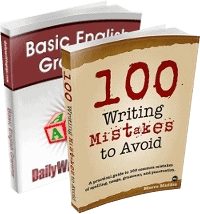
Join Over 50,000 Email Subscribers and Get a Free eBook!

  • Subscribe to DailyWritingTips.com via email and you'll be able to download our ebook, "Basic English Grammar."
  • You will also get all our writing tips delivered to your email inbox, completely free!
  • The download link will go along with the first email (you might need to wait up to 24 hours).

115 Responses to “7 Grammatical Errors That Aren’t”

  1. Alexander Davis on February 7, 2011 3:40 am

    Thank you, Sir!

  2. Mortimer on February 7, 2011 5:02 am

    Nice one!
    It’s good to know the (supposed) rules, but clear communication is obviously better. I like the quote attributed to Winston Churchill,
    “This is the sort of bloody nonsense up with which I will
    not put.”

  3. Deb on February 7, 2011 7:58 am

    Aren’t you cheating with 4 and 5? You claim it’s not necessary to distinguish between them – yet you say you usually do? Way to give mixed messages!

    I do agree with these though. I have had so many arguments about those split infinitives and ending sentences with prepositions. It seems many people are more concerned about what their second grade teacher would think of them, than what their writing actually sounds like!

  4. bite me on February 7, 2011 10:09 am

    Where I work, there are 2 or 3 levels of people that review all of our correspondence before it can go out. This means, by the time they all agree with themselves, about style changes, where the comma goes, what should be capitalized, etc, etc, etc, … it can take months before a letter goes out (currently some have been in Limbo since August 2010). We should do like in Spanish (Castilian), and call the language “castigo”.

    I know, I didn’t put two spaces between sentences, and put the period outside the “…”. But in my personal writing I prefer common sense.

  5. Rebecca on February 7, 2011 11:00 am

    2. Never end a sentence with a preposition.

    My high school English teachers would deduct 2-5 points from our papers if we ended a sentence with a preposition; they believed it was ‘sloppy’ writing. To this day, I will rewrite a sentence to avoid ending it in a preposition. Perhaps it’s time to let it go.

  6. Keith on February 7, 2011 11:01 am

    hurray! thank you highlighting some of these nonsensical ‘errors’.

  7. Lillian Kennedy on February 7, 2011 11:25 am

    Suddenly a great weight has fallen from my shoulders. Thank you so much.
    I have strained mightily to put prepositions back in the middle of sentences and felt creatively crushed by the experience. Now I’ll let them dance in their natural form… if you’re sure that I won’t be arrested?

  8. Becky the Floridian on February 7, 2011 11:27 am

    Only you could make me laugh this early on a Monday morning, Mark. I especially giggled at numbers three and six. And for that, I say thank you. ☺

  9. Jeremy Myers on February 7, 2011 11:54 am

    Great post! I’m writing a book, and some of these rules have been keeping me from saying what I want to say in the way I want to say it. Now I can get back to creativity.

    Thank you!

  10. Roberta B. on February 7, 2011 12:10 pm

    Good list! We speak this way. So, we already understand it. However, in #3, the diction dictator in me says it should read: “…..paragraph; however, a lttle goes a long way.”

  11. Roberta B. on February 7, 2011 12:11 pm

    ….and we make typos, too: “little”

  12. Acolin on February 7, 2011 12:29 pm

    Nice! In plain English too. Love English lessons that make writing fun, rather than clog my brain like cement.

  13. ApK on February 7, 2011 12:34 pm

    The “not ending a sentence in a preposition” rule stems the very common redundant use of a preposition, where it is simply not needed:
    “Where’s the library at?” is wrong simply because the “at” is redundant, not because it’s a preposition.

    Reminds me of a joke:

    On his first day at Harvard, a young freshman from Georgia was exploring the campus and, in his southern drawl, asked an older student:
    “Can you please tell me where the library is at?”

    The student looked down his nose and and said, in his New England accent, “At Harvard, we don’t end our sentences in a proposition.”

    The freshman replied. “Pardon me. Can you please tell me where the library is at, jackass?”

    ApK

  14. ApK on February 7, 2011 12:37 pm

    Darn the lack of an edit feature!
    That was “preposition” not “proposition” That’s very different.

    ApK

  15. shirley in berkeley on February 7, 2011 1:54 pm

    If you substitute “not one” for “none,” which is what “none” means, you haven’t broken any rules in No.7, except for failing to use the singular verb “allows.” The earth may not have stopped spinning, but sloppy writing is sloppy writing. Your noun and verb do not agree.

  16. John White on February 7, 2011 2:29 pm

    Sigh.

    So, when my editor – or more importantly, client – says, “You’ve ended this sentence with a preposition and I want you to fix it,” I should say, “But Marc Nichol posted on a blog with 49K readers that it’s time to get over it.”?

    I.
    Think.
    Not.

  17. Mark Nichol on February 7, 2011 3:18 pm

    John:

    I.
    Think.
    So.

    Diplomacy is required, but you can simply say that such-and-such a rule is no longer considered valid in most cases and you strongly believe that your edit makes the passage flow more easily, but that you of course will leave the final decision to your employer/client.

    Polite assertiveness garners respect.

  18. Terry A McNeil on February 7, 2011 3:38 pm

    Questions. What about general rules petaining to sentence structure? Must have a verb? Subect? Predicate? and so forth?

    Some of my best sentences in context and in my opinion have had just one lonely word. Standing naked. For drama. For personality. To…

    Break all the rules. And you then you may transform language into art. Any thoughts on this rebellious notioni?

  19. Mark Nichol on February 7, 2011 3:53 pm

    Terry:

    Totally. Hella. Word.

    (Just not in the annual report.)

  20. Uriah on February 7, 2011 4:39 pm

    I see what you did there:

    “This rule is ridiculous, to start with.”

    Actually I just wrote Merriam-Webster in regards to a video they have on their website using a terminal preposition and, quite honestly, I still don’t understand all the fuss. None of my teachers were successful in making me care enough about them, at any rate. It’s a ridiculous rule. And if everyone stuck so closely with every grammatical rule to ever have existed we wouldn’t have colloquial English and no change in language at all.

  21. Terry A McNeil on February 7, 2011 4:46 pm

    Mark:

    Just Checking.

    Thanks so much.

    Terry

  22. Vic on February 7, 2011 6:32 pm

    This article comes with a chip on its shoulder, but I like it. It’s very freeing. As I continue to write and write, I find it less and less important to stick to the types of rules mentioned. Not only do people not adhere to the rules when the speak, but they find it uncomfortable to read sentences that sound awkward, even if grammatically correct.

    I am writing a biography at the present and the subject is near 90 and from Brooklyn. Conversationally, he jumps from tense to tense, but this only makes his statements more real and more interesting. Can you imagine making The Sopranos or Boardwalk Empire grammatically perfect?

    I think it’s best to go for communication rather than perfectionism.

  23. Mark Nichol on February 7, 2011 10:09 pm

    Deb:

    Yes, my mixed message is that while and since are valid synonyms for though and because, I often change them when I’m editing because I think it reads better, and one can do worse in being prescriptive. But you don’t have to agree in principle or in practice.

  24. Mark Nichol on February 7, 2011 10:12 pm

    Bite:

    Sounds like the bureaucracy in Brazil. But single spaces between sentences have been the default setting for a long time now. Didn’t they get the memo?

  25. Mark Nichol on February 7, 2011 10:16 pm

    Vic:

    I don’t see any chips when I look out the corner of my eye. What I do see is a lot of people who are self-conscious about fallacious “rules.” I’ve never met anybody who defends these prescriptions, but I’ve talked to and read comments from many people who have.

  26. Mark Nichol on February 7, 2011 10:21 pm

    Roberta:

    You’re confusing two sentence structures that might call for the use of however.

    This is correct as is: “As is obvious from the previous paragraph, however, a little goes a long way.”

    If the first part of a sentence — unrelated, by the way — is an independent clause rather than just an introductory phrase, a semicolon preceding however is correct: “That should be obvious from the previous paragraph; however, what is obvious to one person may not be so to another.”

  27. Mark Nichol on February 7, 2011 10:23 pm

    Uriah:

    So, somebody out there actually watches those videos? The presenters are always noiselessly yakking at me while I look a word up, but I’ve never turned up the volume to actually listen to them.

    Good points.

  28. Red on February 7, 2011 11:10 pm

    I was with you up until number seven. I was taught that none is singular because… Well, let’s use your sentence as an example. “None of these rules…” None is the word that affects the verb in that sentence. “Of these rules” is a prepositional phrase, which does NOT affect the verb. Hence “none” is always singular. No, it doesn’t sound right to the ears. But you can’t disregard rules simply because they don’t sound right to you.

  29. Emma on February 7, 2011 11:23 pm

    I agree that split infinitives are acceptable grammar, but that doesn’t change the fact that I think it weakens the action. Maybe it’s just me, but “to go boldly” sounds much more powerful than “to boldly go”.

    My high-school English teacher marked points off me for using a conjunction at the beginning of a sentence, and included the word “because” under that rule. This makes sense in sentences such as “Because I said so,” where the effect isn’t specified, but she even considered sentences like “Because this happened, this will result,” as incorrect, which always irks me. (That’s not to speak poorly of her, however, because in every other area I agree with her and think she’s a great teacher. I just disagree in a few places about what constitutes “formal” register.)

  30. Birjis Amir Ali on February 8, 2011 12:15 am

    very well written enjoyed reading each of the examples

  31. Helen Hammond on February 8, 2011 7:49 am

    Having just clocked up 28,000 words on a 34,000 word website copy job (yes… you heard it right… someone who wants 34,000 words on their website…) I roared at point number 6. All valid, but that one, in particular, made my day. Thank you.

  32. netta on February 8, 2011 10:36 am

    Thank the heavens above someone has shot these rules in the head. So many writers let the grammar rules affect their creativity, when English is actually a living language and longs to be free!

    This is not advocating sloppy writing, but rather the freedom to use language to convey ideas, thoughts and feelings outside the straitjacket. (Every writer has a straitjacket.)

    Most Excellent post. Thank you.

  33. Roberta B. on February 8, 2011 12:44 pm

    Mark, I stand corrected. In #3, I misread “As is” as “It is,” which would have been an independent clause as pointed out in your clarification. Good topic!

  34. Karen B. on February 8, 2011 2:03 pm

    I actually teach a grammar refresher class for the staff at my organization. I’ve told them that the rule of not ending a sentence in a preposition is going by the wayside … IF restructuring the sentence to avoid it results in awkward phrasing. But I’ve also told them that it’s much more accepted in verbal speech than written communication. And I’ve also told them to reconsider their wording choice to avoid it. For example, instead of “the person you spoke to” try “the person you contacted” or “the person you asked”. Because there are still a lot of people out there who hold this rule as sacrosanct, and it WILL bug them!

  35. Bernie K. on February 8, 2011 2:18 pm

    As always, we need to show good judgment in terms of when and where we apply these freedoms. The first question I ask for any written assignment: Who’s the audience? If you’re going for a conversational tone, go ahead and end the sentence with a preposition. In formal communication, however, you should stick to the rules.

  36. Brendan W. on February 8, 2011 2:21 pm

    I agree with almost everything. But I would add an important caveat to 5 (Distinguish between since and because).
    Having taught journalistic writing to many (including many for whom English is not their first language), I find that this “rule” helps them avoid a great many errors of meaning.
    In a news story or feature the time-reference meaning of the word /since/ or /as/ is very easily read into uses where the causal meaning was intended. Often this is inaccurate and misleading, not just momentarily confusing.
    Most news editors will prefer /because/ to avoid such confusion, yet allow it in a column or editorial — if confusion is quite unlikely.

  37. A.J. Zaethe on February 8, 2011 2:26 pm

    This post was brilliant. Many rules in this area annoy the crap out of me. I just don’t understand, when they make sense. It isn’t like they sound horrible, in fact, they sound fine. I don’t know, but I will defy to the end!

  38. Kathryn on February 8, 2011 4:10 pm

    Shirley:
    “If you substitute “not one” for “none,” which is what “none” means, you haven’t broken any rules in No.7, except for failing to use the singular verb ‘allows.’”

    Actually. . .”none” also means “not any”–and a few other things.

    As Fowler/Gower observed:
    “It is a mistake to suppose that the pronoun is singular only and must at all costs be followed by singular verbs etc.; the OED explicitly states that plural construction is commoner.”
    Fowler’s Modern English Usage: Second Edition

  39. Mark Nichol on February 8, 2011 4:10 pm

    Brendan:

    Good point, and one I’m glad you mentioned because I neglected to: Since can easily be confused as opening a sentence with a temporal reference, so why not use it only in that sense?

    I also change anxious to eager when there is a positive connotation; why dilute a perfectly precise word’s cringing association? (Of course, anxiety can stem from an anticipated or hoped-for positive outcome, but still.)

  40. Mimi on February 8, 2011 4:21 pm

    Hooray for Vic’s comment! I’ll take liberties and rephrase it as, “Let’s go for GOOD COMMUNICATION rather than perfectionism.”

  41. liz on February 8, 2011 4:49 pm

    Just as artists have to learn the rules of perspective before they can break those rules to create their own style, writers should know the rules of grammar and why they exist so they can break them selectively.

  42. Bite Me on February 8, 2011 5:33 pm

    I think the way an explanatory sentence, whose thought is not completed, is abruptly ended with a period, but then the discourse is continued on in a new sentence that begins with “For” is very disruptive (and annoying) to the flow of thought. For then you start thinking “why did they do this -was it because someone said the sentence could only be so long, and this is how they break it up”? After that, you have to re-read the first sentence to see if you missed something that would have been a rational reason for the split.

  43. Mark Nichol on February 8, 2011 5:42 pm

    Bite:

    True, but for has a powerful effect in literary writing (“For God so loved the world . . .”) and should not be banished.

  44. Alan Graner on February 8, 2011 11:18 pm

    Supposedly, when an editor rearranged one of Winston Churchill’s sentences to avoid ending it in a preposition, the Prime Minister wrote back: “This is the sort of bloody nonsense up with which I will not put.” (There are several variations of the statement).

    Since Churchill won a Nobel Prize for Literature in 1953, I’ll continue to end sentences with prepositions.

  45. Roger on February 9, 2011 7:01 am

    All interesting points, totally agree with Mortimer ie, good to know the (supposed) rules but best to communicate properly. However, all points are trivial compared to the cringe making persistence of people who should know better, inc presenters and broadcast journalists to say ‘sat’ instead of sitting. AAARGH!

  46. Justin on February 9, 2011 7:03 am

    Oh, this is wonderful!

    I have been berated for hypocrisy for my strict adherence to, and ‘creative misuse’ of grammar. Sometimes, people say: “does grammar matter if I get the gist?” To which I reply: “Would you be happy to hear your brain surgeon say: “I think I get the gist’” just as you go under anaesthesia?” On the other hand, I keep the euphony rule of “if it sounds right, it’s OK” up my sleeve to stay out of jail.

    Oxford’s brilliant new Guide to Plain English is a must-read, rule-busting buffet on these matters.

    Above all else, I like the opening of the BBC’s style guide which says: “We should not write to make ourselves understood, but to ensure that we are not misunderstood.”

  47. Justin on February 9, 2011 7:11 am

    PS Those upholding the rule about not ending sentences with a preposition should be reminded of Hamlet’s soliloque and “[...] the thousand natural shocks that flesh is heir to.”

    Rules are the children of principles. Rules suffer bending and revision; principles do not. The English language is quirky, beautiful and unmatched in vocabulary. It should be allowed to mature with grace and dignity, but never lose its sophistication. This, I believe, is the principle.

    I propose a prize for whosoever can break ALL of the above 7 rules in one sentence.

  48. Cecily on February 9, 2011 12:03 pm

    Justin: Re the BBC’s style guide saying “We should not write to make ourselves understood, but to ensure that we are not misunderstood”, isn’t that a rather half-hearted aim?

    Fortunately, it now says:
    “It is our job to communicate clearly and effectively, to be understood without difficulty, and to offer viewers and listeners an intelligent use of language which they can enjoy. Good writing is not a luxury; it is an obligation.”

    You can read the whole style guide here; it’s a useful resource:
    http://www.bbctraining.com/pdfs/newsStyleGuide.pdf

  49. Roger on February 9, 2011 12:41 pm

    Does the BBC style guide dictate that people write/ say sat rather than sitting eg, ” I was on the tube sat next to bla bla…”. It’s certainly not ‘an intelligent use of language which I enjoy’… as no one picked up on this when I mentioned it before I guess it doesn’t annoy anyone else. Oh well, off to the satting room for a cuppa.

  50. Bite Me on February 9, 2011 12:44 pm

    Our Branch Leader uses this as a Bible: A Manual for Writers of Term Papers, Theses, and Dissertations, Third Edition, Revised. 1955, 1967 by Kate L. Turabian. Does anyone else?

  51. Bill Furlow on February 9, 2011 5:47 pm

    What was it Winston Churchill said about not ending a sentence with a preposition? To the effect of, “With such nonsense I will not upwith put.”

    Excellent piece, but I’m not sure about No. 7. I don’t see the reason to depart from “none” as singular. It just makes sense to me.

  52. Owen on February 9, 2011 9:43 pm

    There is a rule, not on this list, that I’d like to see more people adhere to. Namely, the distinction between “less” and “fewer”. I hear phrases such as “less people”, “less engineers”, “less reviewers” what feels like all the time, and it drives me up a tree.

    Am I alone in this, or do the rest of you run into similar cringe-inducing uses of “less” for items that can be counted and therefore warrant “fewer”?

  53. Owen on February 9, 2011 9:53 pm

    Ok, just found the post from 2007 on less / fewer:

    http://www.dailywritingtips.com/lessfewer-numberamount-still-salvageable/

    Count me in the group that observes this rule and finds it grating when it’s not observed.

  54. Cecily on February 10, 2011 6:56 am

    Bill: No, Churchill almost certainly didn’t say “up with which I will not put”, despite the story’s persistence (including in this very discussion).

    See Language Log for a debunking: http://itre.cis.upenn.edu/~myl/languagelog/archives/001702.html

    And whatever you do, don’t mention it on any of Geoff Pullum’s Language Log posts:
    http://languagelog.ldc.upenn.edu/nll/?p=2683

  55. Mortimer on February 10, 2011 11:11 am

    @ Cecily

    Somebody said it. The important point is what it illustrates/ridicules. Whether it was Churchill or not, is of secondary importance on a forum of this nature.

  56. Bill Furlow on February 10, 2011 11:26 am

    Owen, You can put me down as one who hears fingernails on the chalkboard (Did Mark Twain originally say that?) when “less” is used when it should be “fewer.” A great example I cite to help folks understand the rule actually came from a razor commercial years ago. It promised “fewer strokes, less irritation.”

  57. Shannon on February 10, 2011 11:49 am

    I’d have to disagree with #7, but considering I minored in Latin and now work as a scientific editor, I think I can be forgiven for that. :)

  58. Wes Morgan on February 10, 2011 1:47 pm

    The proper use of language is a hallmark not of erudition or perceived superiority, but of mental discipline. I consider the “sloppy” use of language indicative of an undisciplined mind.

    Of course, one does not apply a rule such as this to all circumstances. I think it obvious that our expectations are dependent upon the settings in which our conversations take place. One does not expect to hear the same “level” of language in a casual environment that one would expect in a business meeting or courtroom proceeding.

    Thus, my tolerance for the undisciplined use of language is inversely proportional to the importance of the message being conveyed and/or the perceived importance of the speaker. If I am participating in an exchange with a CEO/CIO or other executive, for example, I expect to hear (or read) language that is both precise and grammatically correct; a brainstorming exchange with technical staff, on the other hand, is likely to be far more vernacular in many ways – and I’m comfortable with both.

  59. Sam on February 10, 2011 3:13 pm

    @bite me

    Two spaces are not required, nor preferred when using proportional type as that on a computer. It was used on fixed type devices like typewriters to enhance ease of readability. It served a clear, valid purpose when it was in use and people that didn’t use it were doing a disservice to the reader.

    There should be no comma after the last “etc” in your post; just the ellipses. Periods and other punctuation should fall inside the quotation marks. I’m not entirely sure how you’ve come to the conclusion that doing otherwise is “common sense.”

  60. Tom Williams on February 10, 2011 5:23 pm

    I sometimes amuse myself trying to end a sentence with as many prepositions as possible. My personal best is four. A man registers at a hotel and the clerk says “Take the suitcase you came in with on up.”

  61. Cecily on February 11, 2011 9:08 am

    Sam, where one places periods (full stops) and other punctuation in relation to quotation marks depends on where you or your readers are.

    Your rule is true for AmE (and possibly elsewhere, though I think not), but it is incorrect for BrE. In BrE, you only put punctuation inside quotes if it forms part of the quote (as with brackets).

  62. Cecily on February 11, 2011 9:10 am

    Tom, I can’t take credit for this, but it may amuse you and provide a new challenge for you. It has at least 5 terminal prepositions (although they may not all be used as prepositions here).

    A young boy is sick in bed and asks his mother to read to him. She comes upstairs with a book about Australia that apparently displeases him. He throws it across the room and yells ‘What did you bring that book that I didn’t want to be read to out of about Down Under up for?’

  63. Tom Williams on February 11, 2011 4:33 pm

    @Cecily
    Wonderful! Even if you you remove “about Down Under” it still beats my attempt by one preposition.

  64. Rich on February 13, 2011 1:36 pm

    Done sparingly, breaking any of these rules can add both clarity and impact to prose. Taken to an extreme, ignoring the rules robs writing of the very same.

    Blind adherence to grammar guidelines is equally damaging to the craft.

    Good writing is a balancing act. After all, the best thing about knowing the rules is knowing when — and, frankly, how — to break them.

  65. Elizabeth Fine on February 13, 2011 1:43 pm

    As a college student who has an obsessive disorder with punctuation and grammar, I appreciate this post! I was always taught that sentences must NOT end with prepositions. This eases the pain a little; however, I’m not sure I can let it go yet!

  66. Stephanie Stephens on February 16, 2011 11:14 pm

    I laughed and I cried. As a journalist/copywriter/broadcaster, I quake with fear when I imagine myself committing a grave error.
    AND, my mom and aunt were English profs and the dinner table conversation inevitably included a correction sent my way.

    I can eat without indigestion now.

  67. Ken Cole on February 21, 2011 7:59 pm

    Mark–

    If I may, let me respond point by point.

    1) Not a grammatical rule, you’re right. A distinctly modest use of split infinitives is fine. I used to be slavish about this point but have learned otherwise over the years. As you say, a split infinitive can be a lazy way not to write a better sentence.
    2) Poet Alexander Pope (18th century) started the injunction against prepositions at the end of sentences. It is niggling, but ending a sentence with a preposition is not always good rhetoric, either, just because it feels natural, like talking. Most of us grew up with less than stellar speech exemplars so what feels “natural” is not the best guide. Some slavish teachers may have elevated the “error” to grammar, but it never really was, even for Pope. The problem is rhetorical.
    3) Conjunctions. A bit of a stalking horse of a point here. The last time someone tried to teach this one was 45 years ago. I know. I was there. But starting paragraphs with a conjunction is not usually wise unless you are a skilled writer aiming for a very specific effect. Conjunctions connect one piece to another. Doing so at the beginning of a paragraph—when a paragraph break by its very nature is a break—doesn’t leave much to be connected. Still, never say “never.”
    4) and 5) The point here misses the point. With “while” and “though” and with “since” and “because,” the issue isn’t grammar but precision. You argue, in essence, for imprecision. Imprecision is not a good argument for good writers; the words work best when their root meaning or best metaphorical sense shines through. “Since” makes a very weak “because” in almost every instance. Another stalking horse.
    6) On this one you make your own rule and laugh off the need for authority to do so. In fact, by your own logic because propeller heads now rule the global business universe and do get all the great trophy wives, we ought to be using it in the plural. “Data” is plural. Simple–or not, as you point out, but it bears paying attention to (see point 2 above).
    7) No self-respecting college handbook on grammar defends “none” as exclusively singular. I’m not certain one ever has. Another stalking horse.

    Why all those horses?

  68. Dale on February 28, 2011 6:35 pm

    Sam, it’s people “who”.

  69. Dale on February 28, 2011 6:40 pm

    I forgot to mention that if rules are ignored, chaos in languge would ensue. We would soon be living the Tower of Babel.

  70. venqax on March 8, 2011 7:39 pm

    Great toic, though I must say I thought #s 1 and 2 were long known-deceased. I don’t even recall learning in school that those rules were absolute, and I ain’t no youngster.

    I’m still a grump on #6. When I was in graduate school, the knowledge that the word data was plural– “these data show this”, “the data are in regarding your test”– was something of a shibboleth for who was a “serious” person and who wasn’t, and that has stuck. “Media” used as a singular still makes me put a little black dot by the speakers name in my head too! Some snobberies are resilient, and you never know who might be “keeping score”, LOL.

    I’m not completely unadaptable, though. I wish “whom” would disappear and “I wish I were” was was instead.

  71. Adam iwritereadrate on March 21, 2011 7:44 am

    Really useful tips, will retweet.

    All the best

    Adam
    iWriteReadRate.com

  72. venqax on March 23, 2011 12:26 am

    Don’t know where the following post comes from (somewhere on this forum– copied it for later answer, now can’t find it!). It illustrates, quite accidently, even– dare I say– ironically, the point that splitting infinitives is sometimes not only OK, but PREFERABLE.
    ——————————————-
    Poster: She says: “to automatically start the coffee making process…” How much better to have written, “to start the automatic coffee-making process.” And, yes, a hyphen does belong between “coffee” and “making.”
    Infinitives in all vernaculars of English are the root of the verb. The word “to” (itself of many different uses, including as a preposition; context prevails) is inextricably connected to the root word and no adverb should ever be inserted between them.
    ———————————————

    Of course, the first and second iterations of the sentence do NOT convvey the same message, so, ipso facto, one is not “better” than the other. In the first case, she is starting the coffee-maker (which could well be an ancient perking device for all we know) in an “automatic” manner, i.e, without consciously thinking about it, etc.

    In the second, she is setting a coffee-maker which is itself automatic to some extent (not to the extent of being self-starting, I guess, but it does SOMETHING she thinks is automatic).

  73. Anonymous on April 3, 2011 8:31 am

    ‘Give it up.’ is not an example of using a preposition at the end of a sentence, because ‘up’ is an adverb. I think ‘Am I getting my point across?’ is not, either, although I am not sure.

  74. Ari on April 28, 2011 8:05 am

    Can you confrim the ff: the use of “data” whether used in the singular or the plural also depends on whether the writer is a researcher working in either the qualitative (the data is…) or quantitative (the data are…) paradigm.

  75. Emily on May 3, 2011 3:18 pm

    Brilliant! Yes, there are rules in writing for a reason — and it’s important to know them. However, after years of mastering the language, you learn what sounds good and what doesn’t. And sometimes, that involves ending a sentence with a preposition.

  76. Non-native English speaker on May 12, 2011 11:30 am

    I think that the reason that the sentence “None of these rules, followed strictly, allow for …” works so well is that the “thougth subject” changes from singular (none) to plural (these rules). Compare to this example: “We want as few visitors as possible. One is enough. Indeed, none are even better.” Here, to me, “none is” sounds much better. Admittedly, in this example I tried to isolate “none” from all plural words.

  77. I.ken Seymour on June 14, 2011 3:16 am

    Data is plural, media is plural and for thet matter news is plural. None is singular it means not one. and on another topic, Chairman isnot gender related – it means manager of the chair.

  78. boldly going nowhere on June 30, 2011 7:55 pm

    “1. Never split an infinitive.
    It isn’t wise to always ignore this fallacious rule against dividing the elements of the verb phrase “to (verb)” with an adverb, but to blindly follow it is to prohibit pleasing turns of phrase”

    Never split an infinitive… unless it’s “to blindly follow”?

  79. The Nerdy Nurse on July 9, 2011 6:42 pm

    OH Gosh! Mrs. Barnette would surely be rolling over in her grave is she had a kindle in that coffin of hers!
    She would never let these fly on any of my 6th grade papers!

  80. Peter on July 10, 2011 9:57 pm

    Am I alone in this, or do the rest of you run into similar cringe-inducing uses of “less” for items that can be counted and therefore warrant “fewer”?

    You’re not alone, but your claim that there needs to be a distinction deserves to be on this list (i.e., you are in error).

    Two spaces are not required, nor preferred when using proportional type as that on a computer. It was used on fixed type devices like typewriters to enhance ease of readability. It served a clear, valid purpose when it was in use and people that didn’t use it were doing a disservice to the reader.

    No it wasn’t, and no it didn’t. I don’t know how double-spacing between sentences came about, but it’s far worse in monospaced text (typewriter) than in proportional type. However, traditionally, properly typeset text (at least in fonts designed for books) should have “stretchier” space between sentences (not wider, just stretchier, so when a line of text needs to be adjusted to fit the margins, spaces between sentences get wider than spaces between words…or if it needs to be compressed, interword spaces compress more than intersentence spaces). But when people started using computers to do typesetting, the software they used wasn’t very good and couldn’t cope with many of the things typesetters did, so you don’t see this much nowadays — “modern” typesetting is mostly kind of primitive (computer-based typesetting only became reasonable when Don Knuth wrote TeX in the late ’70s, which was the only typesetter that could do good line breaking for a couple of decades, until Adobe InDesign (using the TeX algorithm). But InDesign is really designed for magazines, not books; the former tend to use narrower fonts and columns, and don’t need stretchier spacing between sentences; InDesign is still deficient in that area (among others).)

    Periods and other punctuation should fall inside the quotation marks. I’m not entirely sure how you’ve come to the conclusion that doing otherwise is “common sense.”

    Well, it is, when the punctuation isn’t part of the quotation! Putting commas and periods that don’t belong in the quotation inside the quotation marks is a typesetting tradition arising from aesthetics, not logic. (And the aesthetic consideration doesn’t apply to handwriting or typewriters, and may not even apply to typeset material using modern techniques.)

  81. venqax on July 19, 2011 7:37 pm

    Where did they get this data? The alternative is to use datum in the singular sense, which makes you sound like a propellerhead.

    No, the alternative is to say “Where did you get these data?”. You don’t have to resort to a propellerism like datum. Just like other plural nouns, in practice, “these cattle, these people-”- because the data you are referring to are almost always a data *set*, not just a single piece of information.

    Where a different and, IMO, WORSE problem happens, is when people referring to a discrete bit as you’re alluding to would say, “Where did you get this statistic?”. AHHH!! The nails, the blackboard….I don’t know the date when any single piece of information became “a statistic”, but it was one of the blackest of days for English, civilization, and mankind. There is where the word datum actually BELONGS and never gets any air-time at all.

  82. Bahati Bohlale on August 3, 2011 12:16 am

    What about “used to” to describe something one did in the past? I don’t understand the origin of this seemingly misappropriation of words. I USED TO say it all the time, but I feel incorrect when I say it now. I do not use it in writing.

  83. Bahati Bohlale on August 3, 2011 12:21 am

    P.S. I will be so excited not to have to worry about not ending a sentence in a preposition, if what you say is true! What I do now is write the preposition at the end of the sentence anyway, and then add, in parentheses, (Never end a sentence in a preposition!)

    I have no idea about my over use of commas.

  84. Bahati Bohlale on August 3, 2011 12:22 am

    overuse

  85. venqax on August 8, 2011 1:49 pm

    @ Bahati: Your question about “used to” is a good one. It is an idiom, certainly, and a very common one. Like many idiomatic expressions it really doesn’t seem to make much sense. when taken apart. AFAIK it is perfectly standard in spoken Gen American. Wouldn’t pass muster in formal writing, tho.

  86. venqax on August 8, 2011 1:52 pm

    premature submition!

    The idiom also has 2 common and distinct meanings: To refer to something in the past, as you say, e.g., “I used to come here all the time”, and also to be adjusted or accustomeed to something, as in, “I used to hate spam, but now I am used to it.”

  87. Chuck Barnard on August 14, 2011 11:01 pm

    In dialog, anything goes–few people in reality bother with formal English in speech. In part because English sentences can be written in any word order and very often be understood. Also, real people often use the wrong word in conversation which seldom matters because in conversation the context may clue you, or you can ask.

    Things written from different POVs may have different language use even in the no-spoken text.

  88. Greg on September 13, 2011 6:45 pm

    Um – whoever this “Bite-Me” person (February 7th) is – they need to learn to write and speak properly. That reply was fraught with errors, and was an outright embarrassment. Then again I guess this is pretty much what we ought to expect from someone who uses such a low class nom-de-plum.

  89. Ben on September 14, 2011 4:29 am

    Greg, if you’re going to be facetious, you should at least endeavour to avoid basic errors of consistency. ‘Bite Me’ is a he or she, but ‘they’ refers to a plural.

    Always heed Matthew’s warning:

    “You hypocrite, first take the log out of your own eye, and then you will see clearly to take the speck out of your brother’s eye”

    –especially when dealing with grammar!

  90. ISG on September 24, 2011 7:39 am

    Interesting comments.
    I have always been interested in the matter of ending a sentence with a preposition. Sometimes the preposition at the end of a sentence is quite correct, because it’s not really a preposition at all, but a sort of appendage to the verb, a reminder of our Anglo-Saxon linguistic heritage. If you are a German scholar, you will know the difference between a separable verb and an inseparable verb. It’s like that. Churchill satirised this brilliantly by consciously using a quasi-inseparable verb (“to put up with”) as if it were a verb + a preposition. One of my favourite quotes!
    A friend of mine once said “A preposition is a word you should never end a sentence with.”

  91. Warsaw Will on October 15, 2011 5:12 am

    @Ben
    I agree with you about Greg’s facetiousness (actually I’d say outright snobbery), but not about his use of singular they, which for many people is absolutely correct here, as he doesn’t know Bite-me’s gender.

    There is rather a good post about this on this very website, just put singular they into the website search box. What’s more in a poll on that post, the vast majority of voters agreed that singular they is the best solution in these circumstances.

  92. Kenneth on October 22, 2011 3:02 am

    What should I do if I am dealing with someone who claims their area of expertise is in English, writing and editing but their grammar is filled with horrendous sentence structuring, typos, poor comprehension and other horrible grammatical errors?

  93. Mark Nichol on October 24, 2011 2:06 pm

    Kenneth:

    Your description of your unfortunate situation is vague. If you are reviewing or editing someone else’s work, all I can advise you is to be respectful but candid. If it’s a client who takes umbrage at your evaluation, invite them to seek a second opinion — or to hire another editor. If it’s a friend or associate, that’s more difficult, because you have a personal relationship with that person — but you must still be honest.

    A writer who seeks a frank assessment and sincerely wants their work to be the best it can be must accept a critique with good grace. If they cannot do so, they should not seek assistance. They are welcome to self-publish and accept full responsibility for the publication’s failure. If they wish to publish in a mediated manner, with editorial oversight, they must expect, and accept, revisions. And if they cannot admit that they are not as skilled as they thought they were, they have no business being a writer.

  94. Kenneth on October 28, 2011 11:54 pm

    Mark

    The person is neither a friend nor an associate. My situation is this. This kid, I call him a kid because he is 10 years younger than I am, calls me an idiot and says I have poor comprehension skills. He goes on and says he is an Editor and that his job as Editor is to correct the mistakes people make.

    While he is saying this and other replies that he makes, he himself makes spelling errors, typos, punctuation errors and exhibits poor sentence structuring. I bring them up to him and his only response was it’s YouTube, he doesn’t care about his spelling or any other error he makes.

  95. Yoly on November 17, 2011 4:46 pm

    I’m with Shirley from Berkeley on #7, as the tense made me, er, tense. With gritted teeth, even. Except, as she admonished your sloppy writing, she didn’t capitalize her name or city. Ah well.

    I might add, that usage can depend somewhat on the type of writing one is doing. For example, I see a lot of sentences beginning with conjunctions in fiction–presumably to create shorter, easier-to-read sentences–where a more formal (and correct) style would normally be used in non-fiction. Always consider the reader.

    Nice site, BTW.

  96. Brian Davison on November 24, 2011 10:53 pm

    Roger, I hope this can help – sorry you’ve waited so long! I come from the north of England where the incorrect “he was sat” instead of “he was sitting” is used extensively. I have not read this in any grammar book but I believe there is a subtle difference in meaning – a difference recognised in some other languages. “He was sitting by the window” implies he was there for quite a time (eg “… throughout the seminar”). “He was sat by the window when he saw a man break into his car” implies he was by the window briefly.

  97. Jordan on December 1, 2011 1:49 am

    Dear Bite Me,

    It was actually punctuationally correct to put the period outside of the quotations because there was only one word, and not a full sentence, inside of them.

  98. Robert on December 1, 2011 5:41 pm

    Rules are not imposed, they are discovered. That’s the prescriptivists’ problem, they are going to be wrong sooner or later. Language change doesn’t result in a debased language – Spanish, French and Italian are not debased forms of Latin. “They” can be singular or plural, it creates no confusion. Shakespeare and the King James Bible used a singular “they”, were they wrong? The word “you” used to be a plural, the language changed. That some teachers will deduct points for not following certain outdated rules doesn’t mean those rules are correct. It is how language is actually used that determines what is correct and what isn’t correct.

  99. venqax on December 8, 2011 4:37 pm

    Ben and Warsaw Will: I think you need to look up the definition of *facetious*. It means, evidently, about the opposite of what you seem to think it does. Greg was not being at all facetious from what I see, but quite directly critical.

    Brian Davidson: In American English the two statements would have unique meanings, too. “He was sitting by the window” would indicate that someone was seated next to the window, presumably of their own free will.” “He was sat by the window” would be a rather odd construction that would indicate the “he” was put there by someone or something, akin to how one might plunk down a houseplant.

  100. danielicious on December 11, 2011 4:46 am

    The simple fact that many people do not remember the rules of the language which they speak is no cause for abandoning those same rules. A philosophical equivalent to this pathetic argument for grammatical incompetence would be “if at first you don’t succeed, set your standards lower”. Although the current rules of English are themselves warped interpretations of the language’s ancestors, failure to abide by current procedure does not equate to evolution; laziness does not warrant validation of one’s poor performance.

    im so sry u feel this way abt gramatical structer n that the way most ppl should b recognized as current valid rules of speech n writing. if 90pcnt of the ppl blieve kidz shoud b allowed to drink booze, does that make it a good idea?

  101. Todd on December 23, 2011 1:23 pm

    I have been a computer engineer for many years (hence a slightly different way of looking at things than the average person), and one thing I have learned is that there is never a datum, even at the quantum level.

    A sentence is a collection of words.

    A word is a collection of letters.

    A letter is a collection of pixels on the screen, or it can be viewed as a one-byte code within the computer.

    A byte is a collection of bits.

    Now you might say that a single binary bit is a datum, however that bit is stored in an electronic circuit comprised of multiple biased silicon junctions, which could be further described using hundreds of physical, electrical, and magnetic properties. On a disk platter, it is stored as a fuzzy area comprised of millions of magnetic alignments of intensities that vary according to the distance from the center of the write magnet as it travelled across the platter. In transit, a bit is a complex waveform in the general shape of a square wave, but affected in myriad ways by many different types of distortion. An in-depth analysis of that waveform would reveal a volume of characteristics that would go on for as long as someone cared to pursue it.

    I could go on. My point is that any datum is subject to endless unraveling all the way down into the quantum world where science shows us that not even a total vacuum is empty or static of characteristics.

    From my perspective, a datum is a subjective definition directly related to individual preferences. Someone out there may view this whole web site as a datum in the sense of how much disk space it takes up or how much bandwidth it consumes. If you are reading this, then you view this web site as data.

    Therefore, and you can quote me on this, “One person’s datum is another person’s data. Always.”

    Signed, Mr. Propellerhead

  102. Wanda on January 2, 2012 11:45 am

    I am saving this post for the sheer entertainment value (because I agree with every point). I laughed through the entire thing. Thanks!

  103. Professor1940 on January 2, 2012 12:14 pm

    When writing I follow most the rules of writing proper English. However, if I am trying to make a point, or a precise thought, I am so happy that the English language allows me to do so.

    The written language should be an enjoyable thing to write and read. English language nerds do not make me happy.

    English of the 15th-18th century is a beautiful thing. Thank God we don’t use it anymore.

  104. venqax on January 23, 2012 4:41 pm

    Todd: My point is that any datum is subject to endless unraveling all the way down into the quantum world where science shows us that not even a total vacuum is empty or static of characteristics.

    Well, yes and no. How’s that for proving your point? If you are describing physical phenomena, your breakdown makes sense. For concepts, it is similar, but different. A word is a concept, an abstract verbal and written symbol or depiction of a “unit” of language. A letter is a physical symbol that represents a sound, or a component of written language, specifically. You describe not a word or a letter, but the mechanics of how written symbols are displayed electronically.

    Yes, every thing can be broken down, reduced infinitely. But the concept of something absolute or irreduceable still exists. Take your example: On one hand, a total vacuum IS, in fact empty of characteristics. By definition, that is what a vacuum IS. It may be equally true that no total vacuum exists in physical reality. So, to grammar. Datum vs. data. The fact that one is treated as singular and one as plural in the grammatical sense is the relevant question. Singular and plural are grammatical concepts in that case. Similarly, *gods* is the grammatical plural of god, regardless how staunchly monotheistic one’s religious beliefs– or even the ultimate truth of the matter– may be.

  105. Thomas Sharkey on February 14, 2012 10:46 am

    Never end a sentence with a preposition.

    So I called out to this guy from my car, “Excuse me, sir, could name a decent cafe here I could go to?”

    He answered, “Around here, we don’t end a sentence with an infinitive.”

    So I said, “My apologies, sir. So, can you tell me of a decent cafe I could go to, asshole?”

  106. Thomas Sharkey on February 14, 2012 11:01 am

    English is the most versatile language in the world.

    German is the mostwidely used (another use of used) language in Europe.

    I find language fascinating, so many different ones, but where would we be without the written word, wether it be roman or asian or etc. etc..

    Think about it.

    No two writers write the same; no two readers “read” the same and to top it all – everybody is entitled to an opinion – and I have never come across two identicle ones yet.

    We humans are versatile and can sometimes be a pain in the… …what was that word?

    To boldly go and write what no man or woman has ever written before should be your authoritic goal in life.

    Sod the grammar nazis, write how you feel, write what you want.

  107. Thomas Sharkey on February 15, 2012 5:15 am

    4 and 5. The choice should not be based on opinion, but context.

    ‘The less said, the better’, or: ‘The fewer said, the better.’?

    Brian Davison.

    The correct term is: “He was seated by the window…”

    He sat…

    He was sitting…

    He sits…

    He seated…

    And to all of you, ‘Nobody is perfect, except maybe in their imperfection’.

    Somebody once said: “Never open a paragraph with dialogue”.

    Bo**ocks.

  108. venqax on February 17, 2012 10:30 pm

    Thomas Sharkey: Great examples of what might, in fact, convey the opposite of what you intend. Your writing is so badly put together, assembled like train wreck is how I “feel”, never mind simply illiterate (indenticle? Really?) that what you are trying specifically to say is murky at best. But, OTOH, and perhaps ironically, it communicates exceedingly well that you are a horrible writer and probably a painful thinker as well. That is a message you might not want to send.

  109. I love grammar on February 29, 2012 2:46 pm

    My high school might have been different, but we were taught that there is formal and informal communication. If I am writing a document for work, I am going to write more formally than I would writing an email to a friend.

    The distinction also exists in verbal communication. I venture that you would speak to the CEO of your company differently than you would to a long time friend. That may not be true, judging from some of the comments.

    The key is to know the context of the communication. If you add the prefix “When writing a formal letter,” to all the rules above, then they all still apply. With the prefix of “When writing a blog,” there exists a little more leeway on the rules.

  110. venqax on March 1, 2012 2:47 pm

    @I love grammar: “Though” I agree about the distinction between formal and informal writing, I would disagree that all of the supposed rules above are appropriate even in the former case. Numbers 1 & 2, e.g., I would argue have never been legitimate rules for English and observing them with rigidity can be downright destructive to communication. Number 3, though I’m not familiar with its origins, also stands out as undeserving of *rule* status, and is better considered a cautionary statement to avoid coming across as too informal in some contexts.

  111. John Wilson on March 28, 2012 4:29 pm

    I’ll give you numbers one through three, but four and five are sensible and six and seven cause me to cringe if used in my presence.

    Improper use of “was” instead of “were” in the subjunctive (as mentioned in the comments above) is another of these, as is the use of “loan” as a verb when the perfectly-good “lend” exists for this purpose.

  112. venqax on April 3, 2012 8:10 pm

    @John Wilson: What do you mean by

    “Improper use of “was” instead of were in the subjunctive (as mentioned in the comments above) is another of these, as is the use of loan as a verb when the perfectly-good “lend” exists for this purpose.”

    The title of the post is 7 Grammatical Errors That Aren’t. So Identifyaing the above as “another of these” I take it you are saying that the subjunctinve was and loan for lend are NOT grammatical errors, but are erroneously cited as such?

  113. Robin on April 23, 2012 1:35 pm

    Can someone please explain why I should avoid writing in the Passive voice? If I am observing a scene, writing what is happening to the actors in that scene, then how do I avoid writing about it in the Passive voice?

  114. Floris on April 27, 2012 12:18 am

    I don’t know where to start; I’ll just offer a few thoughts:
    Sloppy grammar or spelling is an indication of sloppy thinking. “Everybody does it” is a poor excuse.
    If you are going to use a fancy expression, get it right: “Nom de plum” should be “nom de plume” (French: feather, and hence, pen; not English: fruit).
    Datum is Latin for “given”. Data is the plural. Use “dataset” instead of “data” if you don’t want to sound like a propellerhead, yet don’t want to break any grammar rules.
    I attempt not to split my infinitives, and rarely end my sentences with prepositions (Latin: “pre: before, positum: placed”). But as an earlier comment noted: many of these rules are stylistic rather than grammatical; and clarity of expression has to take precedence over pedantic adherence to rules. Keep your audience in mind. Be thankful that you are able read and write, and try to maintain the highest standards that you can.

    At my local grocery, they have a rapid checkout lane with a sign “15 items or fewer”. This makes me happy. Little things please little minds.

    If anyone wants to point out mistakes in my English, please go ahead. It’s my third language, and I’m always happy to learn (although I frequently find that people who learned English as a second / third language know more about grammar than native speakers).

  115. venqax on May 7, 2012 5:17 pm

    Robin: There is no reason why the passive voice cannot be written in by you. It just sounds awkward and stilted at times when it is not necessary. And that is most of the time. So far as your example, tho, of describing actors in a scene, I don’t see how the passive voice would be relevant.??

Have something to say?


Self Publish Your Book!

Popular Articles